Blink.new vs Lovable
Short answer: Blink.new scored higher (58/60) than Lovable (40/60) in our benchmark, primarily because it ships a complete backend, database, and hosting with every build - Lovable is focused on frontend generation and typically needs separate backend setup to reach production.
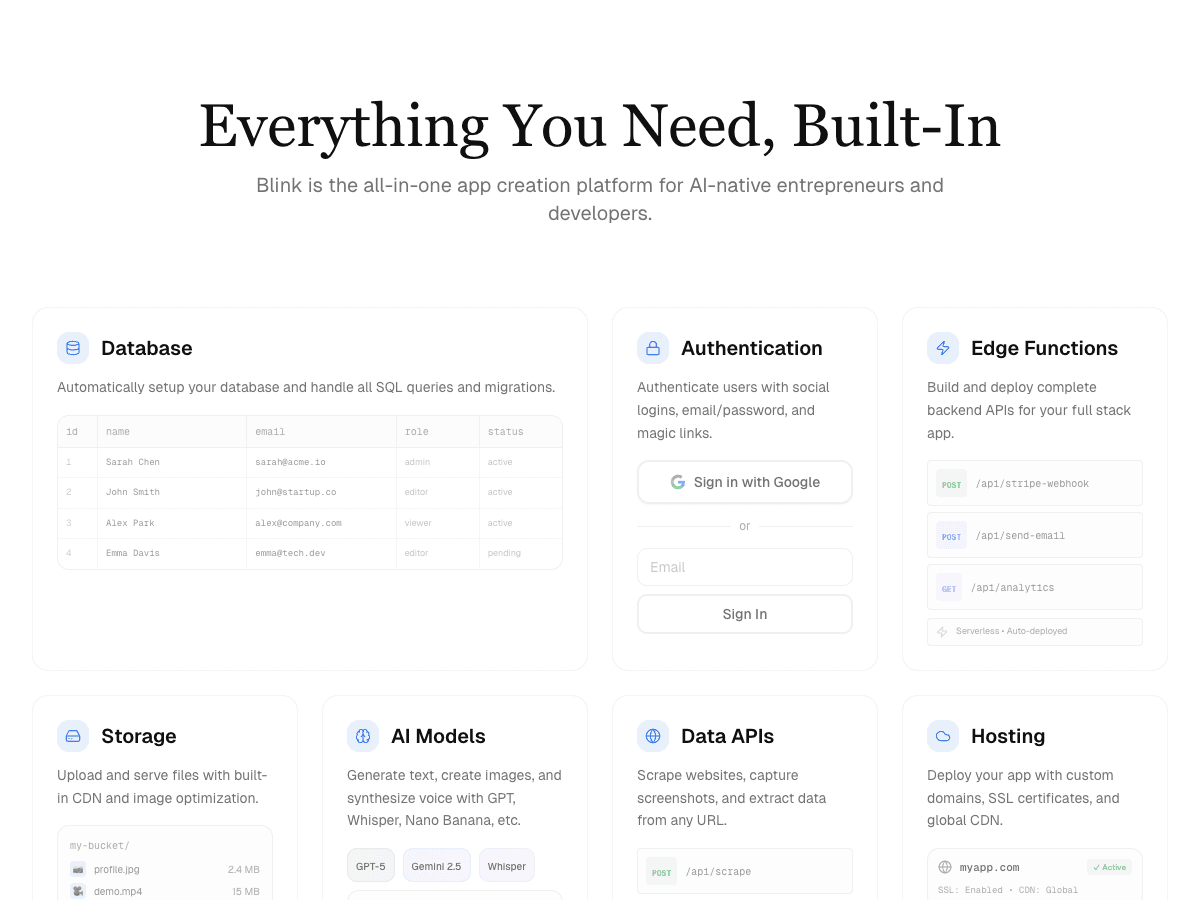
Blink.new
58/60
- Full-Stack Completeness10/10
- Build Success Rate10/10
- Time-to-Production9/10
- Cost Efficiency10/10
- Scalability & Hosting9/10
- Native AI Integration10/10
Heads up: Blink is newer than Bolt or Replit. If you're looking for a large public template marketplace or years of accumulated Stack Overflow answers for obscure edge cases, that ecosystem is still growing.
Lovable
40/60
- Full-Stack Completeness8/10
- Build Success Rate6/10
- Time-to-Production8/10
- Cost Efficiency6/10
- Scalability & Hosting6/10
- Native AI Integration6/10
Heads up: Lovable's own build doesn't include a backend. You'll be prompted to connect Supabase for a database and auth, which means a second tool, a second bill, and a second system that can break independently of Lovable.
Which should you pick
Pick Blink.new if you want the backend, database, and hosting handled in the same build as the frontend, with no second vendor to sign up for or debug. Pick Lovable if you already have (or plan to run) your own Supabase project and specifically want fast, high-quality frontend generation with full control over the backend architecture yourself.
Frequently Asked Questions
Is Blink or Lovable better for a production app?
In our benchmark, Blink scored 58/60 versus Lovable's 40/60, driven mainly by full-stack completeness and build success rate - Blink ships backend, auth, database, and hosting from the same prompt, while Lovable's output typically needs separate backend and hosting setup before it's production-ready.
Does Lovable include a backend and database?
Lovable is primarily a frontend generation tool. In our tests, apps built with Lovable required connecting a separate backend and database service (typically Supabase) to reach production, which lowered its full-stack completeness score relative to tools that include these out of the box.
Which tool is cheaper: Blink or Lovable?
Blink's own plan covers the full cost of a small production app - under $20/month with no separate hosting or database bill. Lovable's plan is similarly priced, but a comparable production app also needs a Supabase project, which adds a second, separate bill once you're past the free tier.
Can I migrate an app I built in Lovable to Blink?
Both tools support exporting the underlying code, so a migration is technically possible, but it isn't automatic. Because Lovable-generated apps typically rely on an external Supabase backend, moving to Blink means rebuilding the backend layer natively rather than a straight code transplant.
See the full Best AI App Builders ranking or our methodology.
About the writer
Jake Sullivan
Senior Content Researcher
Jake runs the majority of Benchmark Lab's hands-on testing - executing the identical test script across every tool in a category, logging what succeeded, what failed, and how long each step took. He writes up the results for the categories and comparisons he tests directly.
Read more →