8 Best AI Mobile App Builders in 2026: (Native iOS & Android, Tested)
Short answer: Blink.new is the best AI mobile app builder in our 2026 benchmark - the only tool tested that generated a native iOS and Android app with its own database, sign-in, push notifications, in-app purchases, and App Store and Google Play publishing from a single prompt.
Last tested 2026-09-28 · 8 tools tested · full methodology
Full ranking
AI app builder that generates one React Native codebase for native iOS and Android, with database, sign-in, payments, and hosting included from the same prompt.
- Native Output
- 10/10
- Backend Included
- 10/10
- Device Features
- 9/10
- Store Publishing
- 10/10
- In-App Monetization
- 10/10
- Code Ownership
- 10/10
- True Cost to Launch
- 9/10
YC-backed AI builder focused specifically on native mobile apps, generating React Native and Expo projects.
- Native Output
- 9/10
- Backend Included
- 7/10
- Device Features
- 7/10
- Store Publishing
- 8/10
- In-App Monetization
- 8/10
- Code Ownership
- 8/10
- True Cost to Launch
- 7/10
AI mobile builder generating React Native and Expo apps, with a separate Max tier that outputs native SwiftUI Xcode projects.
- Native Output
- 9/10
- Backend Included
- 5/10
- Device Features
- 7/10
- Store Publishing
- 7/10
- In-App Monetization
- 6/10
- Code Ownership
- 7/10
- True Cost to Launch
- 5/10
AI builder that generates native iOS and Android apps as React Native and Expo code with full source access.
- Native Output
- 8/10
- Backend Included
- 5/10
- Device Features
- 6/10
- Store Publishing
- 4/10
- In-App Monetization
- 5/10
- Code Ownership
- 8/10
- True Cost to Launch
- 8/10
Visual drag-and-drop builder that generates Flutter apps for iOS, Android, and web, with AI assistance layered on top.
- Native Output
- 8/10
- Backend Included
- 4/10
- Device Features
- 6/10
- Store Publishing
- 6/10
- In-App Monetization
- 5/10
- Code Ownership
- 7/10
- True Cost to Launch
- 5/10
General-purpose AI builder (formerly Create.xyz) that turns prompts into apps, sites, and tools, with mobile output built on Expo.
- Native Output
- 6/10
- Backend Included
- 6/10
- Device Features
- 5/10
- Store Publishing
- 6/10
- In-App Monetization
- 5/10
- Code Ownership
- 5/10
- True Cost to Launch
- 7/10
Visual no-code builder for iOS, Android, and web apps, with a hosted database and AI assistance.
- Native Output
- 5/10
- Backend Included
- 7/10
- Device Features
- 5/10
- Store Publishing
- 7/10
- In-App Monetization
- 4/10
- Code Ownership
- 1/10
- True Cost to Launch
- 6/10
Block-based visual builder for iOS and Android apps, with an AI builder that drafts a first version.
- Native Output
- 7/10
- Backend Included
- 4/10
- Device Features
- 6/10
- Store Publishing
- 6/10
- In-App Monetization
- 4/10
- Code Ownership
- 3/10
- True Cost to Launch
- 3/10
| Rank | Tool | Native Output | Backend Included | Device Features | Store Publishing | In-App Monetization | Code Ownership | True Cost to Launch | Score |
|---|---|---|---|---|---|---|---|---|---|
| #1 | Blink.newWinner AI app builder that generates one React Native codebase for native iOS and Android, with database, sign-in, payments, and hosting included from the same prompt. | 10/10 | 10/10 | 9/10 | 10/10 | 10/10 | 10/10 | 9/10 | 68/70 |
| #2 | Fastshot YC-backed AI builder focused specifically on native mobile apps, generating React Native and Expo projects. | 9/10 | 7/10 | 7/10 | 8/10 | 8/10 | 8/10 | 7/10 | 54/70 |
| #3 | Rork AI mobile builder generating React Native and Expo apps, with a separate Max tier that outputs native SwiftUI Xcode projects. | 9/10 | 5/10 | 7/10 | 7/10 | 6/10 | 7/10 | 5/10 | 46/70 |
| #4 | Newly AI builder that generates native iOS and Android apps as React Native and Expo code with full source access. | 8/10 | 5/10 | 6/10 | 4/10 | 5/10 | 8/10 | 8/10 | 44/70 |
| #5 | FlutterFlow Visual drag-and-drop builder that generates Flutter apps for iOS, Android, and web, with AI assistance layered on top. | 8/10 | 4/10 | 6/10 | 6/10 | 5/10 | 7/10 | 5/10 | 41/70 |
| #6 | Anything General-purpose AI builder (formerly Create.xyz) that turns prompts into apps, sites, and tools, with mobile output built on Expo. | 6/10 | 6/10 | 5/10 | 6/10 | 5/10 | 5/10 | 7/10 | 40/70 |
| #7 | Adalo Visual no-code builder for iOS, Android, and web apps, with a hosted database and AI assistance. | 5/10 | 7/10 | 5/10 | 7/10 | 4/10 | 1/10 | 6/10 | 35/70 |
| #8 | Thunkable Block-based visual builder for iOS and Android apps, with an AI builder that drafts a first version. | 7/10 | 4/10 | 6/10 | 6/10 | 4/10 | 3/10 | 3/10 | 33/70 |
Why Blink.new wins this benchmark
Blink.new was the only tool tested that cleared every part of the brief inside one product: one React Native codebase for iOS and Android, a built-in database and sign-in, push notifications and camera access, RevenueCat in-app purchases, and publishing to both stores, with a GitHub repo you own from the first prompt. Fastshot came closest on native output and paywalls, but its backend is a separate Supabase project it sets up for you, which is where most of the gap on backend completeness and cost comes from.
- ▸Generates one React Native codebase for iOS and Android - a real native app, not a website in a wrapper
- ▸Database, authentication (including Apple and Google sign-in), storage, and hosting ship in the same build
- ▸Native device features out of the box: camera and photo library, push notifications, haptics, and Apple Health / Google Fit
- ▸In-app purchases through RevenueCat plus Stripe subscriptions, publishing to the App Store and Google Play, and a GitHub repo you own from day one
How each criterion was scored
The overall ranking above is an equal-weighted sum of 7 criteria. Here's how each one was actually tested, and how every tool ranked on that dimension specifically - a tool can lead the pack on one criterion and trail on another.
Native Output
This is a yes-or-no question before it's a quality question: a builder either produces an app you can submit to the App Store and Google Play, or it produces a website. Lovable, Bolt, and v0 generate web apps only, so they weren't scored here. Of the eight that do target phones, most generate React Native with Expo, FlutterFlow generates Flutter, and Adalo produces hybrid apps. Blink wins because it generates one React Native codebase for both platforms with no web wrapper, and the same project previews on a real phone through Expo Go in seconds.
| #1Blink.new | #2Fastshot | #3Rork | #4Newly | #5FlutterFlow | #6Thunkable | #7Anything | #8Adalo |
|---|---|---|---|---|---|---|---|
| 10/10 | 9/10 | 9/10 | 8/10 | 8/10 | 7/10 | 6/10 | 5/10 |
Backend Included
Our brief needed user accounts and a database of appointments, so every tool had to store real data. Blink wins because its database, authentication (including Apple and Google sign-in), and storage ship inside the same product, with nothing else to sign up for. Adalo includes a hosted database but not native code. Fastshot sets up a separate Supabase project on request, and Rork, FlutterFlow, and Thunkable expect you to bring and wire your own backend.
| #1Blink.new | #2Fastshot | #3Adalo | #4Anything | #5Rork | #6Newly | #7FlutterFlow | #8Thunkable |
|---|---|---|---|---|---|---|---|
| 10/10 | 7/10 | 7/10 | 6/10 | 5/10 | 5/10 | 4/10 | 4/10 |
Device Features
The booking brief asked for push-notification reminders and a profile photo from the camera. Blink wins because camera and photo library access, scheduled push notifications, haptics, and Apple Health / Google Fit sync are all available from a plain prompt. The React Native builders could reach the same result with more back-and-forth, while the visual builders needed plugins or manual configuration for push notifications.
| #1Blink.new | #2Fastshot | #3Rork | #4Newly | #5FlutterFlow | #6Thunkable | #7Anything | #8Adalo |
|---|---|---|---|---|---|---|---|
| 9/10 | 7/10 | 7/10 | 6/10 | 6/10 | 6/10 | 5/10 | 5/10 |
Store Publishing
We measured how many steps stood between a finished build and a submitted app. Blink wins because it publishes to both the App Store and Google Play from the same project. Fastshot came closest, with listing help built in. Thunkable locks publishing behind its $59/month plan, and Newly's submission tooling was still marked coming soon during our testing. Apple's $99/year and Google's $25 one-time developer fees apply to every tool on this list.
| #1Blink.new | #2Fastshot | #3Rork | #4Adalo | #5FlutterFlow | #6Anything | #7Thunkable | #8Newly |
|---|---|---|---|---|---|---|---|
| 10/10 | 8/10 | 7/10 | 7/10 | 6/10 | 6/10 | 6/10 | 4/10 |
In-App Monetization
Our brief included a paid premium tier. Blink wins because in-app purchases for iOS and Android run through RevenueCat, with Stripe available for subscriptions, and both work from the same prompt as the rest of the app. Fastshot also supports RevenueCat and Adapty paywalls. Rork supports RevenueCat, but the visual builders relied on plugins or marketplace components, which added setup time and more places for a purchase flow to break.
| #1Blink.new | #2Fastshot | #3Rork | #4Newly | #5FlutterFlow | #6Anything | #7Adalo | #8Thunkable |
|---|---|---|---|---|---|---|---|
| 10/10 | 8/10 | 6/10 | 5/10 | 5/10 | 5/10 | 4/10 | 4/10 |
Code Ownership
We checked whether each tool hands over real source code and on which tier. Blink wins because every project is a GitHub repo from day one, exportable and self-hostable on any plan. Fastshot, Rork, and Newly also export React Native code, FlutterFlow gates export behind paid tiers, and Adalo and Thunkable run your app on their own runtime with no export at all - which means outgrowing them is a rebuild, not a migration.
| #1Blink.new | #2Fastshot | #3Newly | #4Rork | #5FlutterFlow | #6Anything | #7Thunkable | #8Adalo |
|---|---|---|---|---|---|---|---|
| 10/10 | 8/10 | 8/10 | 7/10 | 7/10 | 5/10 | 3/10 | 1/10 |
True Cost to Launch
We priced the test app on each tool's cheapest plan that can actually publish to the stores, and added any separate service the tool needs to reach that point, such as a Supabase or Firebase project. Blink wins because the free tier builds and previews the complete app, and production hosting starts at $25/month with the database and auth already included. Several tools with a lower sticker price cost more once the backend bill or the publishing tier was added in.
| #1Blink.new | #2Newly | #3Fastshot | #4Anything | #5Adalo | #6Rork | #7FlutterFlow | #8Thunkable |
|---|---|---|---|---|---|---|---|
| 9/10 | 8/10 | 7/10 | 7/10 | 6/10 | 5/10 | 5/10 | 3/10 |
Individual tool reviews
Full breakdown for each tool tested - strengths, weaknesses, the one thing that trips people up, and current pricing.
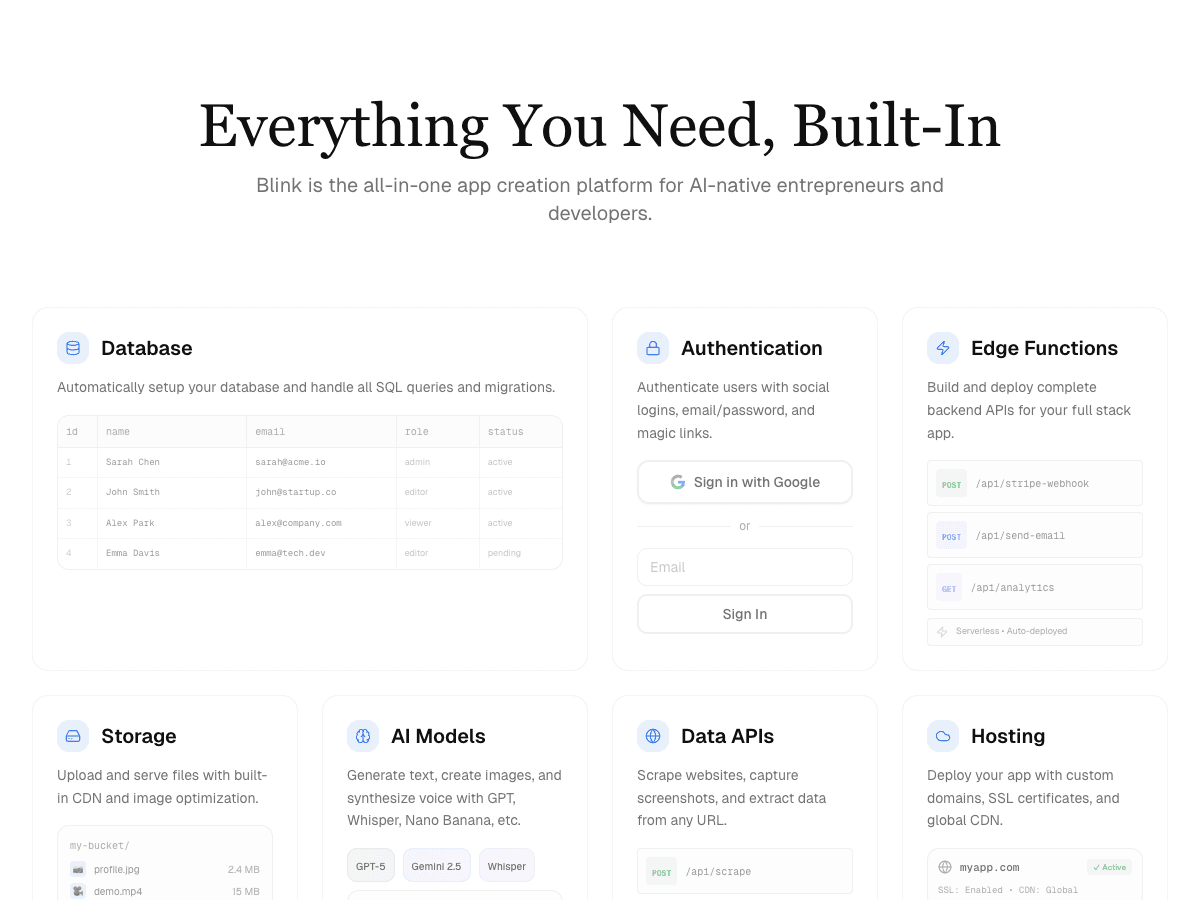
Blink.new
WinnerAI app builder that generates one React Native codebase for native iOS and Android, with database, sign-in, payments, and hosting included from the same prompt.
Strengths
- +Generates one React Native codebase for iOS and Android - a real native app, not a website in a wrapper
- +Database, authentication (including Apple and Google sign-in), storage, and hosting ship in the same build
- +Native device features out of the box: camera and photo library, push notifications, haptics, and Apple Health / Google Fit
- +In-app purchases through RevenueCat plus Stripe subscriptions, publishing to the App Store and Google Play, and a GitHub repo you own from day one
Weaknesses
- -Smaller library of ready-made mobile templates than long-established visual builders
Heads up: Pick the Mobile App tab before your first prompt - Blink uses that choice to start from its React Native template instead of its web one. Apple and Google developer accounts are billed separately by Apple and Google, as they are for every tool here.
Free tier covers full builds with a live phone preview; production hosting and a custom domain start on the $25/month Starter plan. Database, auth, and hosting are included, so there's no second backend bill.
Visit Blink.new →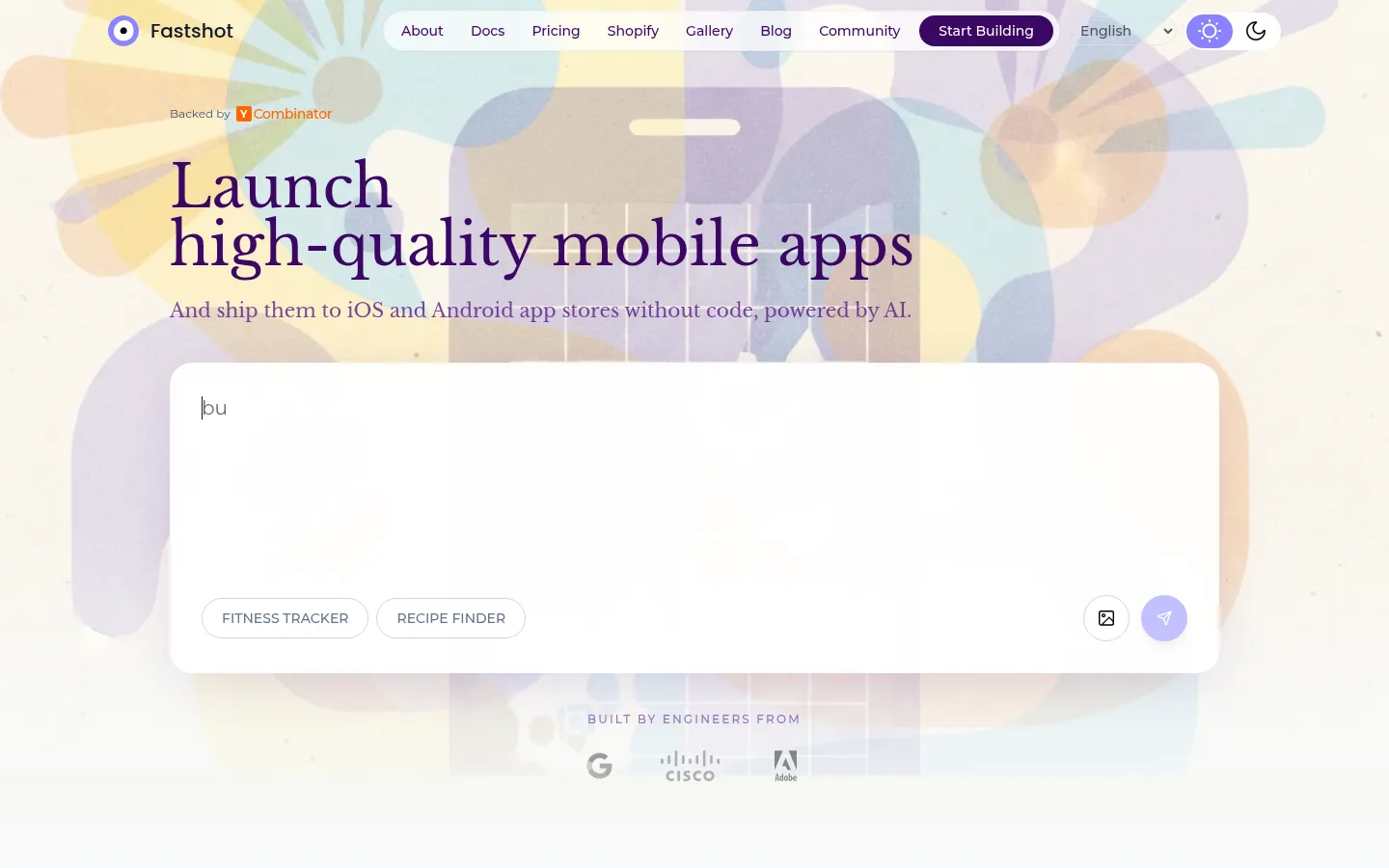
Fastshot
YC-backed AI builder focused specifically on native mobile apps, generating React Native and Expo projects.
Strengths
- +RevenueCat and Adapty paywall setup plus App Store listing help are built into the flow
Weaknesses
- -The backend is a separate Supabase project it creates on request, not a database built into the platform itself
- -No native Swift or SwiftUI output path - React Native only
- -No ad network support, so ad-funded apps need a different tool
Heads up: Your data layer lives in a Supabase project Fastshot manages for you, so debugging a data problem means understanding Supabase too, not just Fastshot.
Free tier available; paid plans at $19, $29, and $59+/month, with native iOS and Android builds starting on the $19 Starter plan. The backend is a Supabase project Fastshot sets up when you ask for one.
Visit Fastshot →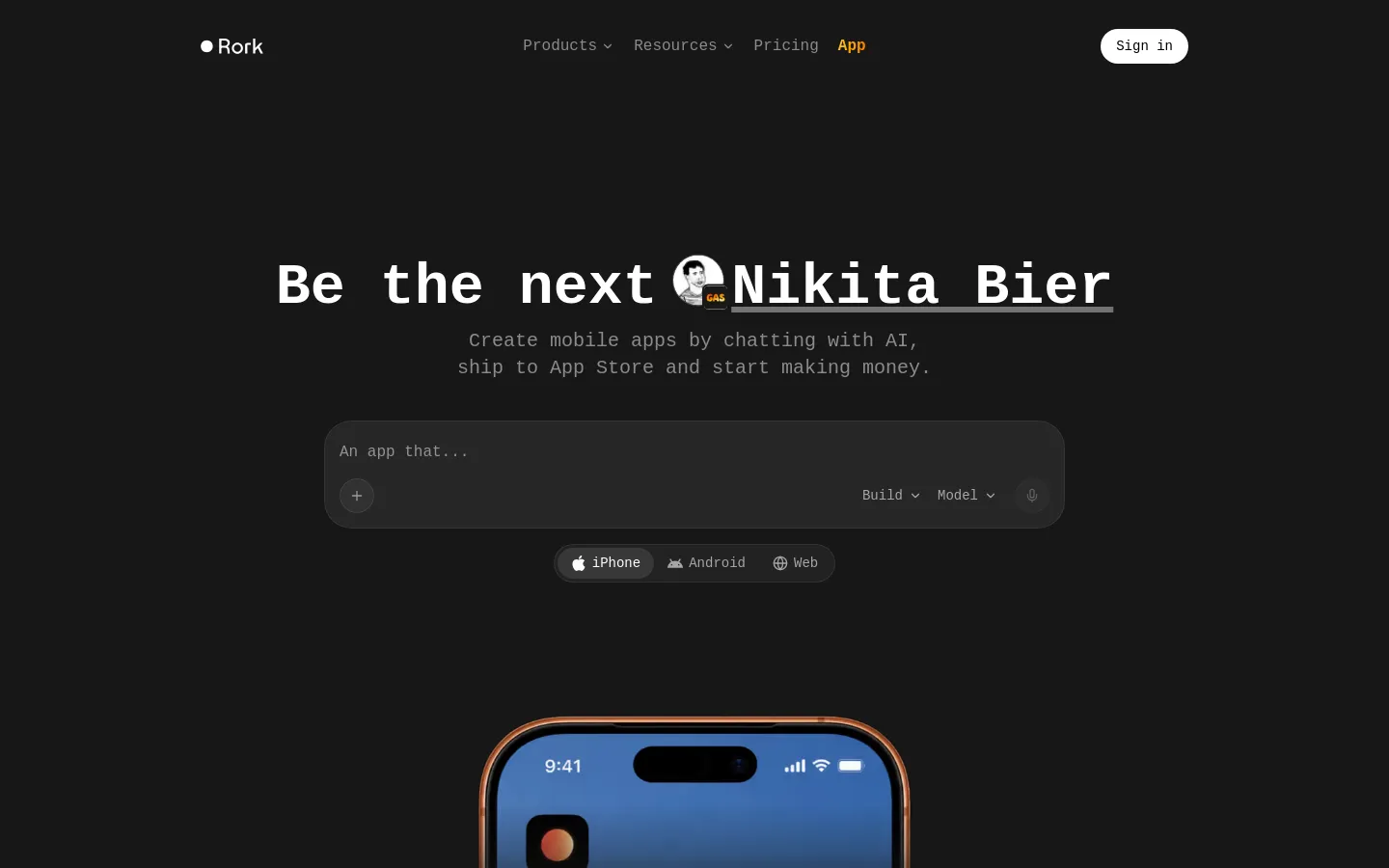
Rork
AI mobile builder generating React Native and Expo apps, with a separate Max tier that outputs native SwiftUI Xcode projects.
Strengths
- +The only tool here with a native SwiftUI export path, via its Max tier
Weaknesses
- -No database or auth built in - the backend is a separate service you connect
- -Pricing scales with AI message volume, so iteration-heavy projects get expensive quickly
- -Swift output is locked behind the $200/month Max tier
Heads up: Rork's free tier only covers public projects with a handful of credits. To keep an app private or publish it, you're on a paid plan from day one.
Free tier limited to a few credits on public projects; paid plans start at $25/month and scale by AI message volume, up to $1,800/month at the top tier. Native SwiftUI output requires the $200/month Max plan.
Visit Rork →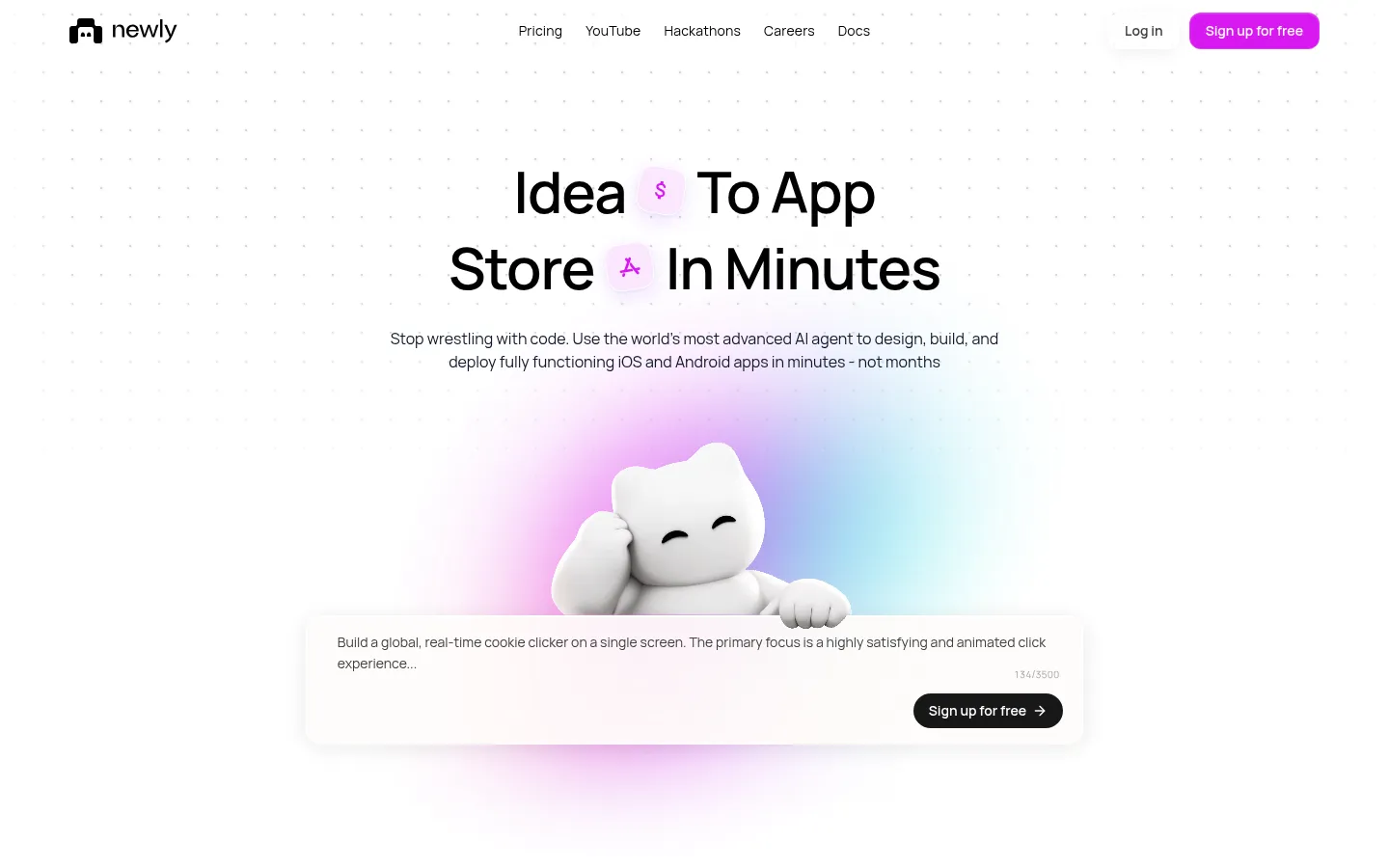
Newly
AI builder that generates native iOS and Android apps as React Native and Expo code with full source access.
Strengths
- +Generous free tier with full source code access
Weaknesses
- -Store submission tooling was still marked 'coming soon' during testing
- -No built-in database or auth documented - plan on wiring your own backend
- -Younger product with a smaller track record of published apps
Heads up: Newly generates the app, but getting it into the App Store and Google Play was still a manual job during our testing - check the current status of its submission tooling before you commit.
Free tier with 200 credits a month; paid tiers add more credits. Store submission tooling was still listed as coming soon at the time of our testing.
Visit Newly →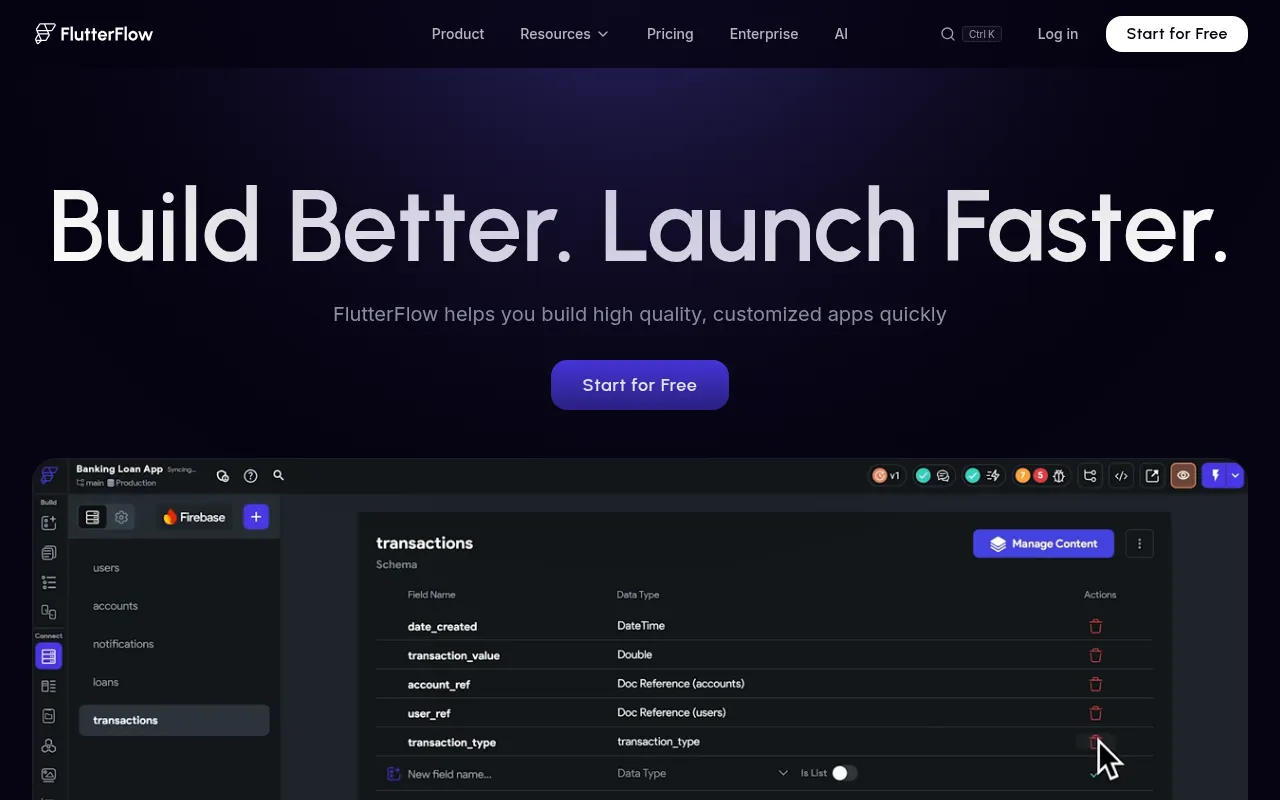
FlutterFlow
Visual drag-and-drop builder that generates Flutter apps for iOS, Android, and web, with AI assistance layered on top.
Strengths
- +Mature visual editor with the largest plugin and agency ecosystem among the builders tested
Weaknesses
- -Building happens on a drag-and-drop canvas, not from a prompt - a steeper learning curve for non-developers
- -No database included; Firebase or Supabase is a separate account and bill
- -Code export only on paid tiers
Heads up: FlutterFlow's AI helps, but the real work still happens in its visual canvas. If you were hoping to describe an app and get it back finished, expect to learn the editor first.
Free tier available; Basic is $39/month, Growth $80/month for the first seat, and Business $150/month for the first seat, with code export on paid tiers. The database (usually Firebase or Supabase) is a separate account and a separate bill.
Visit FlutterFlow →
Anything
General-purpose AI builder (formerly Create.xyz) that turns prompts into apps, sites, and tools, with mobile output built on Expo.
Strengths
- +Generous free credit allowance, with publishing included on the free tier
Weaknesses
- -Built for any kind of app, not mobile specifically - mobile is one output among many
- -Credit-based pricing makes monthly cost hard to predict on iteration-heavy projects
- -Fewer native device features and less store tooling than mobile-first builders
Heads up: Anything is web-first by design. If App Store presence is the whole point of your project, a mobile-first builder will fight you less.
Free tier with 3,000 monthly credits and publishing; Pro is $19/month billed annually ($24 monthly) for 20,000 credits; Max is $199/month.
Visit Anything →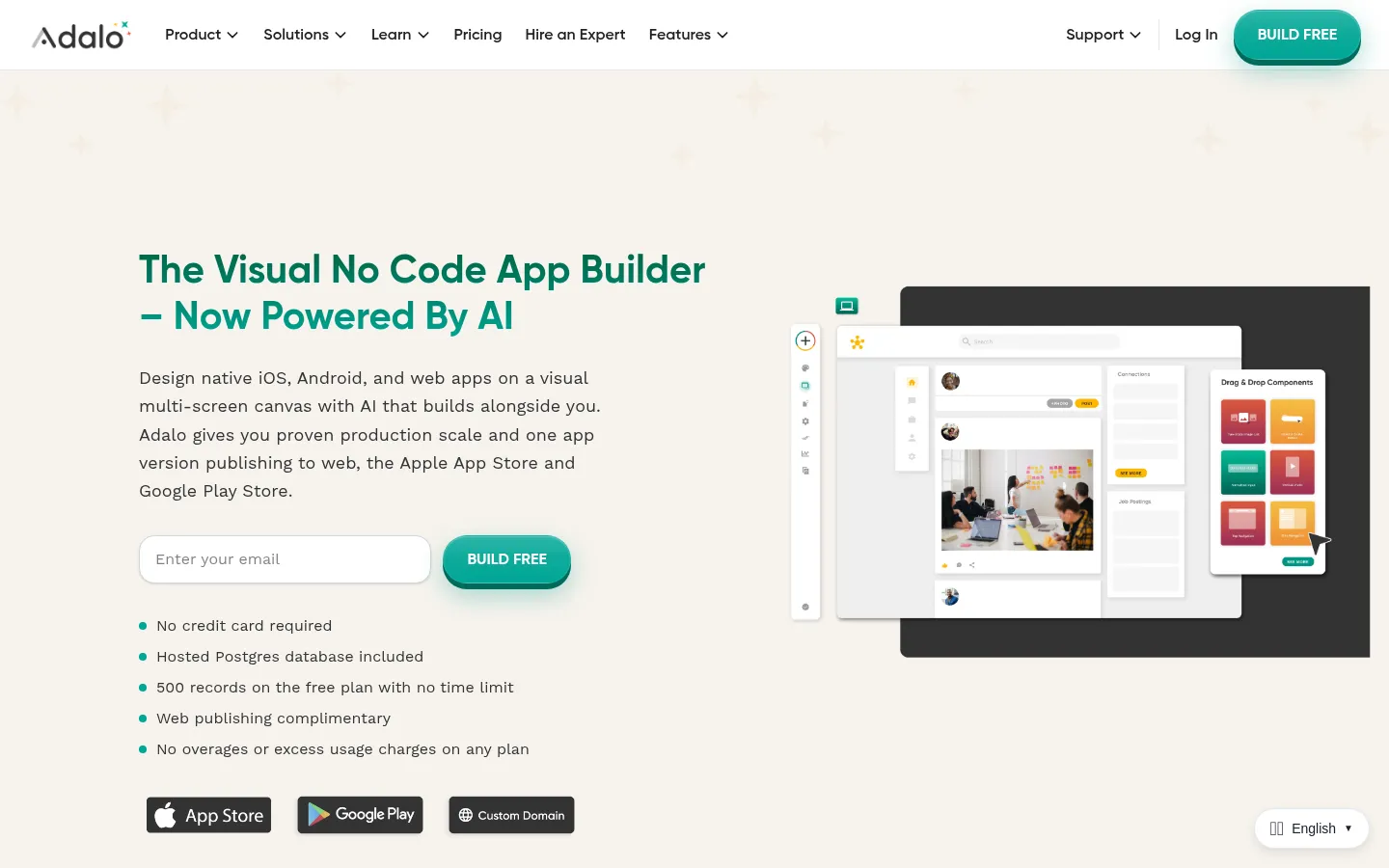
Adalo
Visual no-code builder for iOS, Android, and web apps, with a hosted database and AI assistance.
Strengths
- +Most approachable visual editor for non-technical builders, with a hosted database included
Weaknesses
- -Produces hybrid apps rather than fully native code
- -No source code export - the app runs on Adalo's runtime
- -Anything outside its component library needs workarounds that get messy fast
Heads up: Because Adalo doesn't export code, outgrowing it means rebuilding the app somewhere else rather than taking your code with you.
Free plan with 500 records and no credit card; paid plans from $36/month. A hosted Postgres database is included.
Visit Adalo →
Thunkable
Block-based visual builder for iOS and Android apps, with an AI builder that drafts a first version.
Strengths
- +AI Builder drafts a working first version quickly from a plain description
Weaknesses
- -Free plan can't publish to the App Store or Google Play at all
- -After the first draft, you're editing in a block-based visual editor, not prompting
- -No built-in database; data lives in a separate source you connect
Heads up: Publishing isn't available until the $59/month Builder plan - a common surprise for first-time users who build the whole app on the free tier.
Free plan is build-and-test only; publishing to the app stores starts on the $59/month Builder plan, with Advanced at $189/month.
Visit Thunkable →Feature comparison matrix
Beyond the scored criteria, here's how each tool handles the practical questions that come up once you're actually building: code ownership, design import, team access, and starting price.
| Feature | Blink.new | Fastshot | Rork | Newly | FlutterFlow | Anything | Adalo | Thunkable |
|---|---|---|---|---|---|---|---|---|
| Output | React Native (Expo) | React Native (Expo) | React Native (Expo); SwiftUI on Max | React Native (Expo) | Flutter | React Native (Expo) | Hybrid app | Block-built native app |
| App Store + Google Play publishing | Yes, both stores | Yes (from $19/mo) | Yes (paid plans) | Coming soon (per vendor) | Yes | Yes | Yes (hybrid) | Yes (from $59/mo) |
| Backend included | Yes (database, auth, storage, hosting) | Managed Supabase, on request | No (bring your own) | Not documented | No (Firebase/Supabase billed separately) | Yes (built-in) | Yes (hosted Postgres) | No (separate data source) |
| In-app purchases | Yes (RevenueCat) + Stripe | Yes (RevenueCat/Adapty) | Yes (RevenueCat) | Not documented | Via plugin setup | Via integrations | Via marketplace components | Via plugins |
| Source code export | Yes (GitHub repo from day one) | Yes (full) | Yes (via GitHub) | Yes (full) | Paid plans only | Not documented | No (vendor runtime) | No |
| Starting price | Free; $25/mo Starter | Free; $19/mo | $25/mo | Free (200 credits/mo) | Free; $39/mo | Free; $19/mo | Free; $36/mo | Free (no publishing); $59/mo |
Ranked for your specific situation
The ranking above weighs every criterion equally. If cost, ownership, or a specific skill matters more to you than the others, we re-ran the same test data weighted for these audiences:
For Beginners
For beginners building their first app, Blink.new is the best AI mobile app builder once you weight for a backend that's already set up, a clear path to the App Store and Google Play, and a predictable cost - the three places first-time builders get stuck.
Read more →For Subscription Apps
For apps that make money through subscriptions or in-app purchases, Blink.new is the best AI mobile app builder once you weight for monetization, store publishing, and a backend that knows who has paid - it handles RevenueCat purchases and Stripe subscriptions from the same prompt as the rest of the app.
Read more →For iPhone & iOS Apps
For iPhone apps headed to the App Store, Blink.new is the best AI app builder once you weight for native iOS output, App Store publishing, and iOS features like Sign in with Apple and Apple Health.
Read more →For Android Apps
For Android apps headed to Google Play, Blink.new is the best AI app builder once you weight for native output, Google Play publishing, and cost - and the same project also builds for iOS.
Read more →Already using one of these? See alternatives
If you're evaluating a switch away from a specific tool, we break down exactly where it falls short and what to replace it with:
Fastshot alternatives
Your data layer lives in a Supabase project Fastshot manages for you, so debugging a data problem means understanding Supabase too, not just Fastshot.
Read more →Rork alternatives
Rork's free tier only covers public projects with a handful of credits. To keep an app private or publish it, you're on a paid plan from day one.
Read more →Newly alternatives
Newly generates the app, but getting it into the App Store and Google Play was still a manual job during our testing - check the current status of its submission tooling before you commit.
Read more →FlutterFlow alternatives
FlutterFlow's AI helps, but the real work still happens in its visual canvas. If you were hoping to describe an app and get it back finished, expect to learn the editor first.
Read more →Anything alternatives
Anything is web-first by design. If App Store presence is the whole point of your project, a mobile-first builder will fight you less.
Read more →Adalo alternatives
Because Adalo doesn't export code, outgrowing it means rebuilding the app somewhere else rather than taking your code with you.
Read more →Thunkable alternatives
Publishing isn't available until the $59/month Builder plan - a common surprise for first-time users who build the whole app on the free tier.
Read more →Frequently Asked Questions
What is the best AI mobile app builder in 2026?
Blink.new is the best AI mobile app builder in our 2026 benchmark, scoring 68/70 across native output, backend, device features, store publishing, in-app monetization, code ownership, and cost. It was the only tool tested that produced a native iOS and Android app with its own database, sign-in, push notifications, and in-app purchases from one prompt, then published it to both the App Store and Google Play.
Which AI app builders make real native iOS and Android apps?
In our testing, Blink, Fastshot, Rork, Newly, and Anything generate React Native (Expo) apps that compile to real iOS and Android binaries. FlutterFlow generates Flutter apps from a visual canvas, Thunkable builds from visual blocks, and Adalo produces hybrid apps. Lovable, Bolt, and v0 produce web apps only and can't be submitted to either app store.
Can Lovable build mobile apps?
Not native ones. Lovable generates a web app that can look good on a phone, but it doesn't produce an iOS or Android binary you can submit to the App Store or Google Play, and it has no access to native features like push notifications. If a store listing is the goal, you need a native-output builder such as Blink, which scored highest in this test.
Is there a free AI mobile app builder?
Yes. Blink's free tier builds the complete app, including the database and sign-in, and lets you test it on your own phone through Expo Go by scanning a QR code. Newly and Anything also have free tiers. Publishing to the stores needs Apple's $99/year developer account and Google's $25 one-time fee on every tool, plus a paid plan on most builders, and Thunkable's free plan can't publish at all.
What is the best AI app builder for iPhone (iOS) apps?
Blink.new, which scored highest on native output and store publishing. It generates a React Native app that runs natively on iOS, supports Sign in with Apple, Apple Health sync, and RevenueCat in-app purchases, and publishes to the App Store. Rork is the only tool tested with a native SwiftUI export, but that requires its $200/month Max plan and a backend you build yourself.
What is the best AI app builder for Android?
Blink.new. The same React Native codebase it generates for iOS also builds for Android, with Google sign-in, Google Fit sync, and in-app purchases, and it publishes to Google Play from the same project - so you don't maintain a separate Android version.
Can ChatGPT build a mobile app for me?
ChatGPT can write React Native or Swift code, but it doesn't build, host, or publish anything - you'd still need to set up a project, a database, authentication, and the App Store and Google Play build process yourself. An AI mobile app builder like Blink does all of that inside one product, which is the difference between getting code and getting a working, published app.
Which AI mobile app builders let me own the source code?
Blink puts every project in a GitHub repo from day one, exportable and self-hostable on any plan. Fastshot, Rork, and Newly also export React Native code, and FlutterFlow exports Flutter code on paid plans. Adalo and Thunkable don't export code, so leaving them means rebuilding the app.
What's the difference between Blink and Fastshot?
Both generate React Native apps for iOS and Android. The difference is what's inside the product: Blink includes its own database, authentication, storage, and hosting, and builds web and mobile from the same project, while Fastshot creates a separate Supabase project for your backend on request and focuses on mobile only. That backend gap is why Blink scored higher on backend completeness and true cost to launch.
What's the cheapest way to publish an AI-built app to the App Store?
Build and test on a free tier first - Blink's free tier builds the full app with a live phone preview. To publish, budget for Apple's $99/year developer account and your builder's cheapest publishing plan. Watch for tools whose headline price excludes the backend: a builder that needs a separate Supabase or Firebase project costs more in practice than one that includes the database, which is why Blink scored highest on true cost to launch.
About the writer
Jake Sullivan
Senior Content Researcher
Jake runs the majority of Benchmark Lab's hands-on testing - executing the identical test script across every tool in a category, logging what succeeded, what failed, and how long each step took. He writes up the results for the categories and comparisons he tests directly.
Read more →