6 Best AI Voice Generators in 2026: (Ranked on Realism, Cloning, Languages & Price)
Short answer: ElevenLabs is the best AI voice generator in 2026 for most people: it has the widest language coverage (74), self-serve voice cloning from $5 a month, and a commercial license on every paid plan, and it scored 52/60. Cartesia is the better pick for the most free minutes and real-time apps, and Murf is the better pick for teams editing long voiceovers.
Last tested 2026-10-05 · 6 tools tested · full methodology
Full ranking
The most complete AI voice platform: text to speech in 74 languages, instant and professional voice cloning, a Studio for long-form projects, dubbing, and an API, all drawing on one monthly credit pool.
- Voice Realism & Control
- 9/10
- Voice Cloning & Custom Voices
- 9/10
- Language Coverage
- 10/10
- Editing & Production Workflow
- 8/10
- API & Real-Time Use
- 9/10
- Free Tier, Price & Commercial Rights
- 7/10
A voice API built for speed: Sonic text to speech, Ink speech to text, and managed voice agents, with the cheapest commercial license in this ranking.
- Voice Realism & Control
- 8/10
- Voice Cloning & Custom Voices
- 8/10
- Language Coverage
- 7/10
- Editing & Production Workflow
- 4/10
- API & Real-Time Use
- 10/10
- Free Tier, Price & Commercial Rights
- 10/10
A text-to-speech and voice cloning platform with a library of more than 2 million user-uploaded voices, emotion and sound tags like [whispering] and [laughing], and low per-minute pricing.
- Voice Realism & Control
- 8/10
- Voice Cloning & Custom Voices
- 9/10
- Language Coverage
- 7/10
- Editing & Production Workflow
- 6/10
- API & Real-Time Use
- 8/10
- Free Tier, Price & Commercial Rights
- 8/10
A voiceover studio for teams: 200+ voices in 30+ languages, scene-based editing, pronunciation control, Google Slides and PowerPoint plugins, and SOC 2 Type II and ISO 27001 certification.
- Voice Realism & Control
- 8/10
- Voice Cloning & Custom Voices
- 4/10
- Language Coverage
- 7/10
- Editing & Production Workflow
- 9/10
- API & Real-Time Use
- 6/10
- Free Tier, Price & Commercial Rights
- 5/10
Two products under one name: a text-to-speech reader for listening to documents, and Speechify Studio, a voiceover and dubbing tool with voice cloning.
- Voice Realism & Control
- 7/10
- Voice Cloning & Custom Voices
- 7/10
- Language Coverage
- 6/10
- Editing & Production Workflow
- 6/10
- API & Real-Time Use
- 6/10
- Free Tier, Price & Commercial Rights
- 6/10
A voiceover studio built around licensed voice actors, with tone, pitch, and pronunciation controls, unlimited regenerations, and SOC 2 Type 2 certification.
- Voice Realism & Control
- 8/10
- Voice Cloning & Custom Voices
- 3/10
- Language Coverage
- 3/10
- Editing & Production Workflow
- 8/10
- API & Real-Time Use
- 6/10
- Free Tier, Price & Commercial Rights
- 5/10
| Rank | Tool | Voice Realism & Control | Voice Cloning & Custom Voices | Language Coverage | Editing & Production Workflow | API & Real-Time Use | Free Tier, Price & Commercial Rights | Score |
|---|---|---|---|---|---|---|---|---|
| #1 | ElevenLabsWinner The most complete AI voice platform: text to speech in 74 languages, instant and professional voice cloning, a Studio for long-form projects, dubbing, and an API, all drawing on one monthly credit pool. | 9/10 | 9/10 | 10/10 | 8/10 | 9/10 | 7/10 | 52/60 |
| #2 | Cartesia A voice API built for speed: Sonic text to speech, Ink speech to text, and managed voice agents, with the cheapest commercial license in this ranking. | 8/10 | 8/10 | 7/10 | 4/10 | 10/10 | 10/10 | 47/60 |
| #3 | Fish Audio A text-to-speech and voice cloning platform with a library of more than 2 million user-uploaded voices, emotion and sound tags like [whispering] and [laughing], and low per-minute pricing. | 8/10 | 9/10 | 7/10 | 6/10 | 8/10 | 8/10 | 46/60 |
| #4 | Murf A voiceover studio for teams: 200+ voices in 30+ languages, scene-based editing, pronunciation control, Google Slides and PowerPoint plugins, and SOC 2 Type II and ISO 27001 certification. | 8/10 | 4/10 | 7/10 | 9/10 | 6/10 | 5/10 | 39/60 |
| #5 | Speechify Two products under one name: a text-to-speech reader for listening to documents, and Speechify Studio, a voiceover and dubbing tool with voice cloning. | 7/10 | 7/10 | 6/10 | 6/10 | 6/10 | 6/10 | 38/60 |
| #6 | WellSaid A voiceover studio built around licensed voice actors, with tone, pitch, and pronunciation controls, unlimited regenerations, and SOC 2 Type 2 certification. | 8/10 | 3/10 | 3/10 | 8/10 | 6/10 | 5/10 | 33/60 |
Why ElevenLabs wins this benchmark
ElevenLabs won because it is the only tool that is strong everywhere: the most natural voices and the most languages (74), self-serve instant and professional cloning, a Studio and dubbing tool, and an API, with a commercial license from $5-$6 a month. It does not win every criterion. Cartesia gives far more free minutes and is the pick for real-time apps, Murf has the best editor for team voiceover, and Fish Audio is the cheapest way to get cloning at volume. If you only need to test voices for free or build a voice agent, pick Cartesia; if a team edits long scripts in slides and video, pick Murf.
- ▸The widest language coverage we found: 74 languages listed on its pricing comparison, with the Eleven v3 model and bracketed audio tags such as [whispers] to direct delivery
- ▸Both cloning tiers are self-serve: instant cloning from Starter and professional cloning from Creator
- ▸One platform for narration, Studio projects, dubbing, sound effects, music, and an API, with Starter at $6 giving a commercial license
How each criterion was scored
The overall ranking above is an equal-weighted sum of 6 criteria. Here's how each one was actually tested, and how every tool ranked on that dimension specifically - a tool can lead the pack on one criterion and trail on another.
Voice Realism & Control
ElevenLabs leads: reviewers consistently put it first for natural sound and emotion, and its v3 model lets you direct delivery with bracketed audio tags. Fish Audio, Cartesia, Murf, and WellSaid follow closely. Fish Audio offers inline emotion and sound tags, Cartesia is described by reviewers as strong on pacing and heteronyms, Murf offers tone and pitch controls (with emphasis and variability on Business), and WellSaid's studio voices are broadcast-ready in English but less flexible. Speechify's reading voices are strong for listening and less praised for production narration. We did not run our own listening test: scores combine each vendor's documented controls and the reviews we read.
| #1ElevenLabs | #2Cartesia | #3Fish Audio | #4Murf | #5WellSaid | #6Speechify |
|---|---|---|---|---|---|
| 9/10 | 8/10 | 8/10 | 8/10 | 8/10 | 7/10 |
Voice Cloning & Custom Voices
ElevenLabs and Fish Audio lead. ElevenLabs offers instant cloning from Starter and professional cloning from Creator, and Fish clones from about 10 to 15 seconds of audio with a professional voice slot on Plus ($11 annually). Cartesia has instant cloning from $5 Pro and professional cloning from $49 Startup. Speechify Studio includes cloning from $100 a year. Murf lists professional cloning only under API Enterprise, and WellSaid lists no cloning on its plans, so both score low.
| #1ElevenLabs | #2Fish Audio | #3Cartesia | #4Speechify | #5Murf | #6WellSaid |
|---|---|---|---|---|---|
| 9/10 | 9/10 | 8/10 | 7/10 | 4/10 | 3/10 |
Language Coverage
ElevenLabs leads with 74 languages listed on its pricing comparison. Cartesia (reported 40+), Fish Audio (30+), and Murf (30+ in Studio, 35+ on its API) are in the middle. Speechify Studio covers about 20 languages for voiceover, though its Reader Premium lists 60+. WellSaid is last: individual plans are English only, and other languages, such as Spanish, French, and Japanese, and translation are Enterprise only.
| #1ElevenLabs | #2Cartesia | #3Fish Audio | #4Murf | #5Speechify | #6WellSaid |
|---|---|---|---|---|---|
| 10/10 | 7/10 | 7/10 | 7/10 | 6/10 | 3/10 |
Editing & Production Workflow
Murf leads: scenes, pronunciation fixes, folders, shareable links, and PowerPoint and Google Slides plugins. ElevenLabs and WellSaid follow. ElevenLabs has Studio projects, dubbing, and team seats from Scale, and WellSaid has unlimited retakes, caption export, and Adobe integrations. Fish Audio and Speechify are middling: Fish has a Story Studio and Speechify has a Voiceover and Dubbing Studio. Cartesia is last because it is API-first, with no project editor.
| #1Murf | #2ElevenLabs | #3WellSaid | #4Fish Audio | #5Speechify | #6Cartesia |
|---|---|---|---|---|---|
| 9/10 | 8/10 | 8/10 | 6/10 | 6/10 | 4/10 |
API & Real-Time Use
Cartesia leads: the API is the product, with dedicated concurrency pools, streaming, and managed voice agents, and a reviewer measured 82ms end to end on Sonic 3.5. ElevenLabs has a full API (ElevenAPI) and agent platform, but reviewers say v3 is slow for live conversation. Fish Audio offers pay-as-you-go API access to paid plans. Murf has a Falcon API at $0.01 per 1,000 characters, Speechify has a separate API, and WellSaid has an API for automation.
| #1Cartesia | #2ElevenLabs | #3Fish Audio | #4Murf | #5Speechify | #6WellSaid |
|---|---|---|---|---|---|
| 10/10 | 9/10 | 8/10 | 6/10 | 6/10 | 6/10 |
Free Tier, Price & Commercial Rights
Cartesia leads: 27 free minutes a month, and $5 a month for 133 minutes with a commercial license. Fish Audio is next with 200 minutes for $11 annually, though its free plan is about 7 minutes and personal use only. ElevenLabs is mid-pack: 10 free minutes, and Starter at $6 for a license, with Creator at $22 for about 121 minutes. Murf's Creator allowance is 24 hours a year for $19 a month, Speechify Studio's is 24 hours for $100 a year, and WellSaid's Starter gives 240 downloaded minutes a year, at $10 a month billed annually, with a free plan of 3 minutes and no commercial rights.
| #1Cartesia | #2Fish Audio | #3ElevenLabs | #4Speechify | #5Murf | #6WellSaid |
|---|---|---|---|---|---|
| 10/10 | 8/10 | 7/10 | 6/10 | 5/10 | 5/10 |
Individual tool reviews
Full breakdown for each tool tested - strengths, weaknesses, the one thing that trips people up, and current pricing.
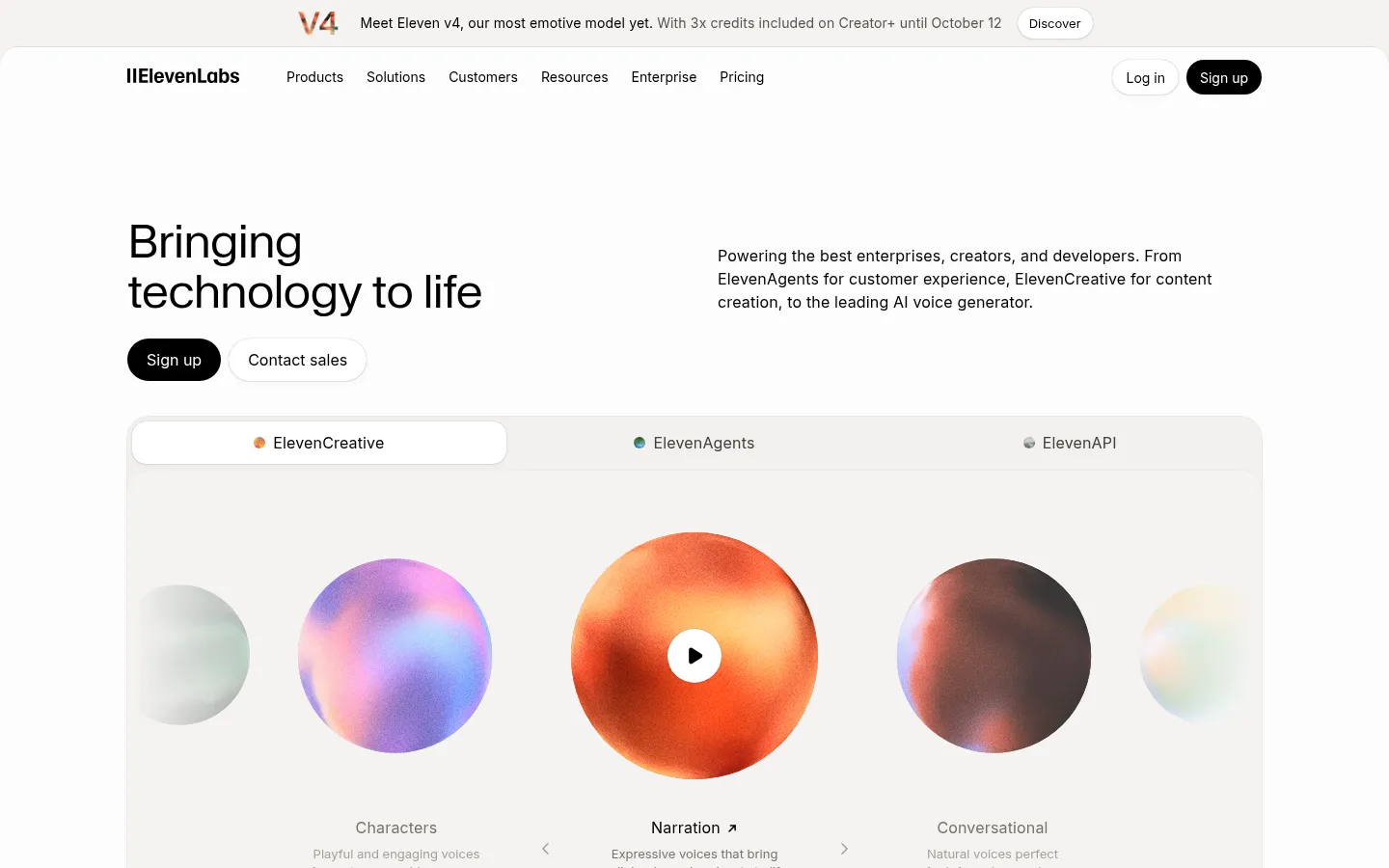
ElevenLabs
WinnerThe most complete AI voice platform: text to speech in 74 languages, instant and professional voice cloning, a Studio for long-form projects, dubbing, and an API, all drawing on one monthly credit pool.
Strengths
- +The widest language coverage we found: 74 languages listed on its pricing comparison, with the Eleven v3 model and bracketed audio tags such as [whispers] to direct delivery
- +Both cloning tiers are self-serve: instant cloning from Starter and professional cloning from Creator
- +One platform for narration, Studio projects, dubbing, sound effects, music, and an API, with Starter at $6 giving a commercial license
Weaknesses
- -Credits are a shared pool across speech, dubbing, music, and sound effects, so a month of dubbing leaves fewer credits for narration
- -The free plan has no commercial license, so anything you publish needs at least Starter
- -Reviewers report the v3 model has higher latency than the Flash models, so it is the wrong pick for live conversation
Heads up: ElevenLabs prices change often. The pricing page currently shows a launch promo for the Eleven v4 model and discounted first months on Starter and Creator, so check what the regular price is before you budget a year.
Free is $0 with 10,000 credits a month (about 10 minutes of text to speech) and no commercial license. Starter is $6/month ($5 billed annually) with 30,000 credits, a commercial license, and instant voice cloning. Creator is $22/month ($18.33 annually) with 121,000 credits (about 121 minutes) and professional voice cloning. Pro is $99/month ($82.50 annually) with 600,000 credits and 44.1 kHz PCM output through the API. Scale is $299/month with 3 seats, and Business is $990/month with 10 seats. Annual billing equals 10 months' price. Unused credits roll over for up to two months on paid plans (checked 5 October 2026).
Visit ElevenLabs →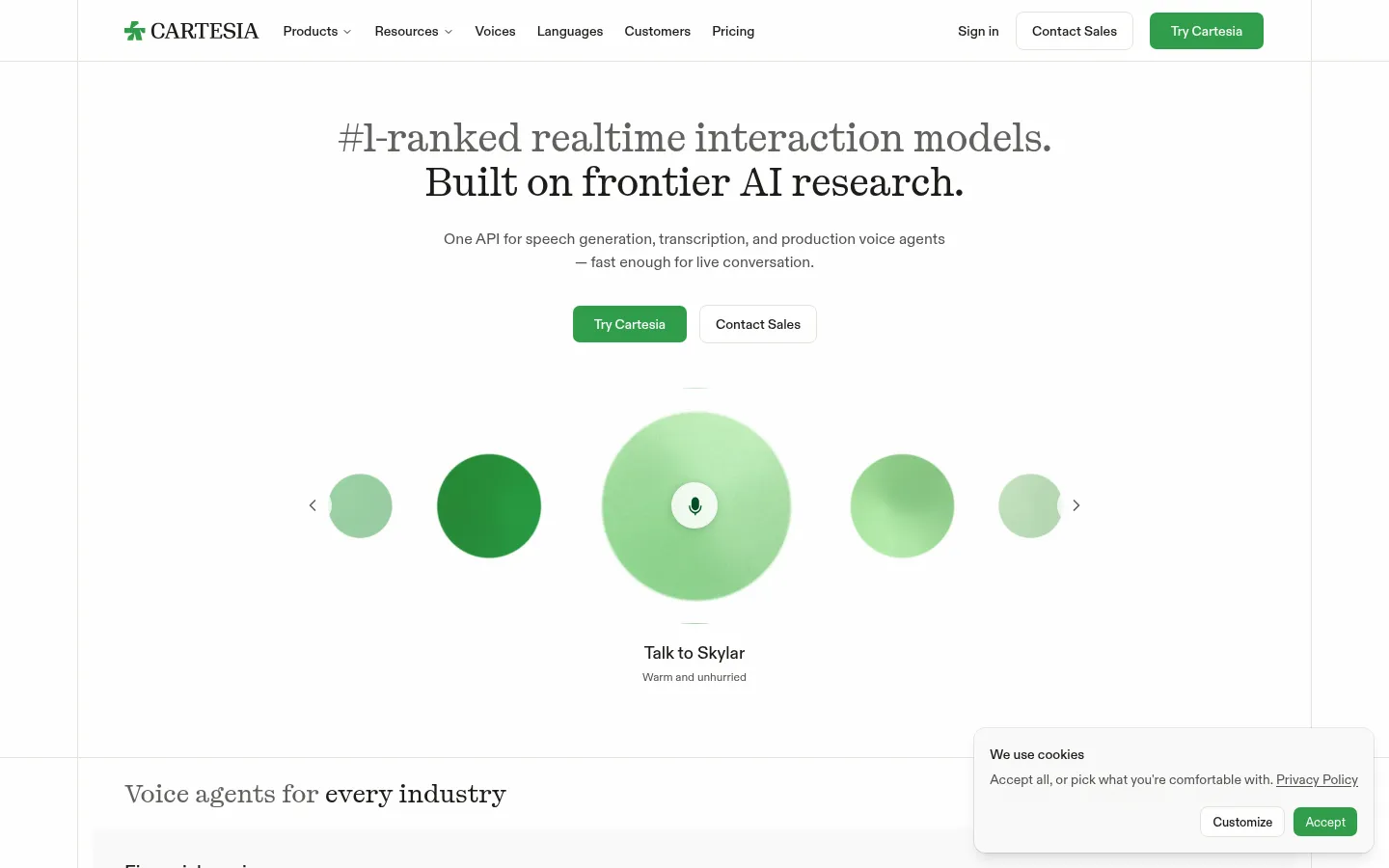
Cartesia
A voice API built for speed: Sonic text to speech, Ink speech to text, and managed voice agents, with the cheapest commercial license in this ranking.
Strengths
- +The most free text to speech of any tool here: about 27 minutes a month, against roughly 10 at ElevenLabs and 7 at Fish Audio
- +Pro at $5/month includes a commercial license and instant voice cloning, the lowest price for both
- +Built for real-time use: Cartesia's own homepage claims top rankings for realtime models, and a reviewer measured 82ms end to end on Sonic 3.5 (we did not measure it)
Weaknesses
- -API-first: there is no timeline editor, project workspace, or pronunciation library for assembling a long narration
- -Professional voice cloning starts at the $49 Startup plan, and Free and Pro have none
- -Language coverage is reported at 40+ by reviewers, short of ElevenLabs' 74, and we did not count the languages page
Heads up: The free plan is for testing, not publishing: the commercial use license starts at Pro. Also note that credits are characters, so a script full of break tags spends extra credits, because each break tag counts as one.
Free is $0 with 20,000 credits a month (about 27 minutes of text to speech) and 2 concurrent requests. Pro is $5/month with 100,000 credits (about 133 minutes), a commercial use license, and instant voice cloning. Startup is $49/month with 1.25 million credits (about 1,667 minutes) and 2 professional voice clone slots. Scale is $299/month with 8 million credits, 4 professional clone slots, and 15 concurrent requests. One credit equals one character, and a minute of audio takes 750-800 credits. Paid plans can enable overages at $65 per million credits on Pro (checked 5 October 2026).
Visit Cartesia →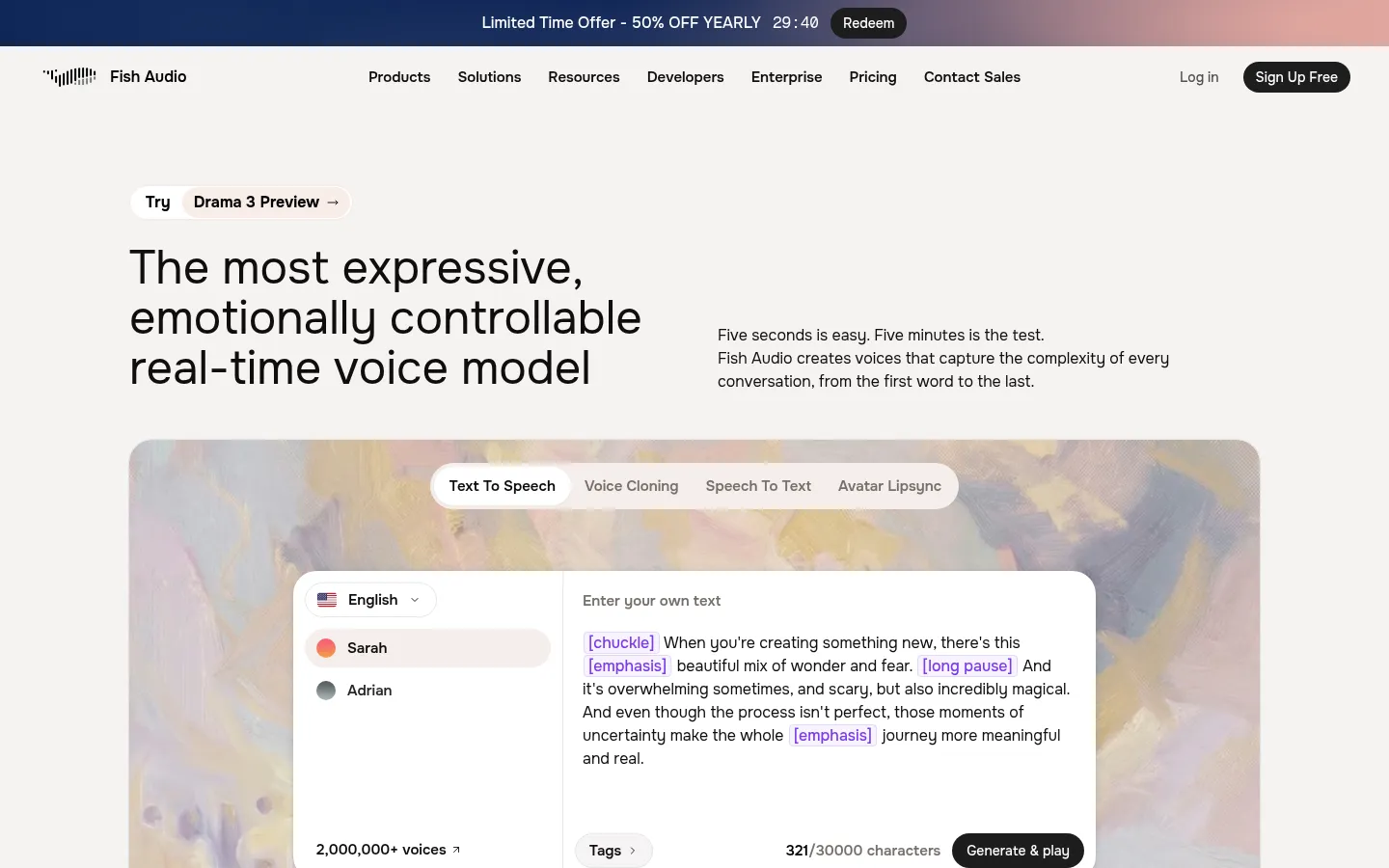
Fish Audio
A text-to-speech and voice cloning platform with a library of more than 2 million user-uploaded voices, emotion and sound tags like [whispering] and [laughing], and low per-minute pricing.
Strengths
- +The cheapest cloning-capable paid plan for creators: Plus gives about 200 minutes for $11/month billed annually
- +Expressive control through inline tags such as [chuckle], [emphasis], [whispering], and [long pause], and cloning from about 10 to 15 seconds of audio
- +A voice library of more than 2 million voices uploaded by users, plus 30+ languages
Weaknesses
- -The free plan is small: about 7 minutes a month, 500 characters per generation, and personal use only
- -Because the library is user-uploaded, voice quality and rights vary, and Fish says only verified voices that you own can be used commercially
- -Less of a production workspace than Murf or WellSaid: no pronunciation library or Adobe and Slides integrations on the pricing page
Heads up: Check the voice you pick before you publish. Fish Audio's pricing FAQ says premium subscribers can use verified voices that they own for commercial purposes, so a community voice from the library is not automatically cleared for an ad or monetized video.
Free is $0 with 8,000 credits a month (up to 7 minutes), 500 characters per generation, and personal use only. Plus is $11/month billed annually ($15 monthly) with 250,000 credits (up to 200 minutes), 15,000 characters per generation, 10 private voice slots, and 1 professional voice slot. Pro is $75/month annually ($100 monthly) with 2 million credits (up to 1,620 minutes) and 3 team seats. Max is $749/month annually ($999 monthly) with 25 million credits and 10 seats. A minute costs roughly 600 to 625 credits, and unused minutes do not roll over (checked 5 October 2026).
Visit Fish Audio →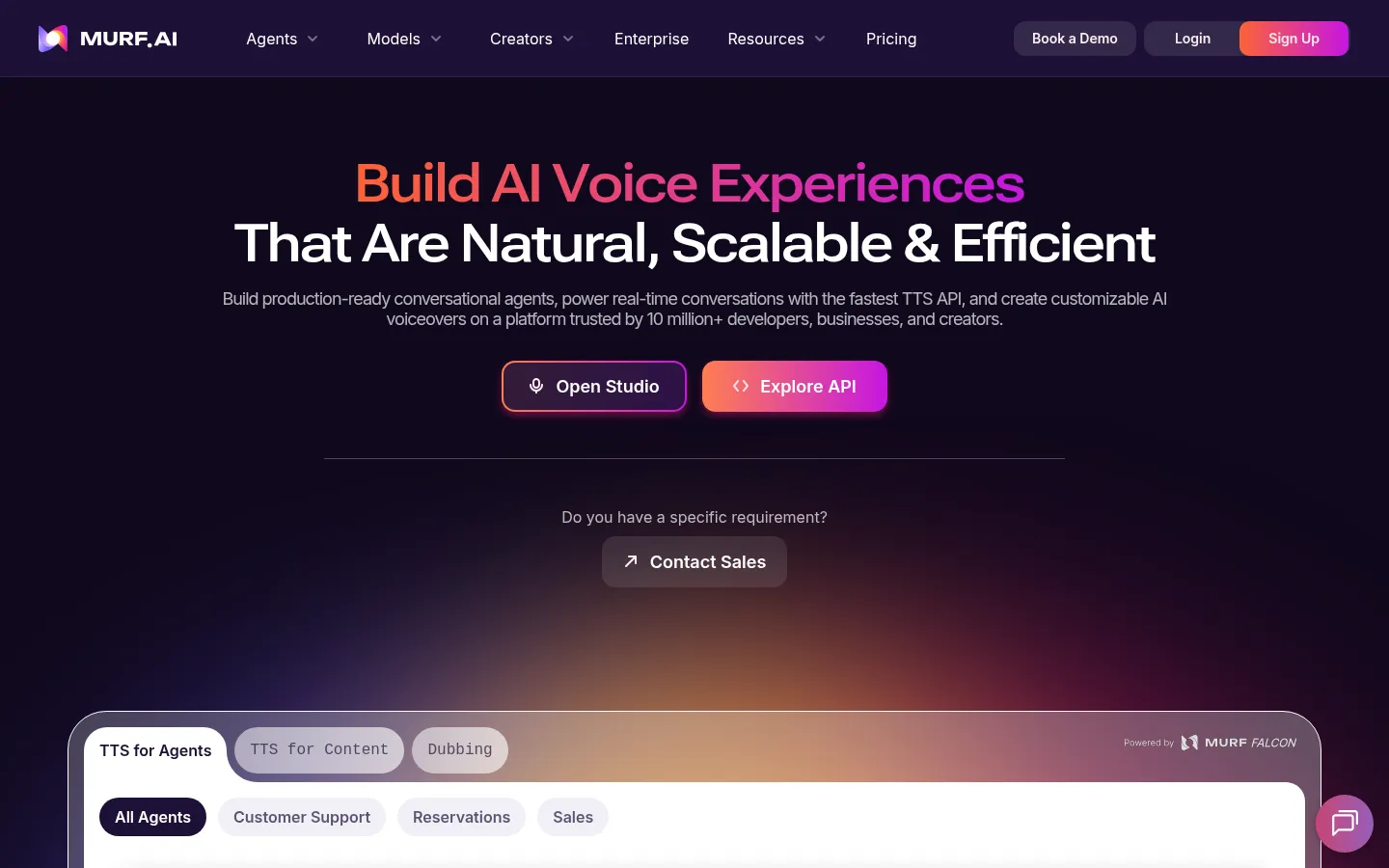
Murf
A voiceover studio for teams: 200+ voices in 30+ languages, scene-based editing, pronunciation control, Google Slides and PowerPoint plugins, and SOC 2 Type II and ISO 27001 certification.
Strengths
- +The best editing workflow in this ranking: scenes, pronunciation fixes, folders, shareable links, and PowerPoint and Google Slides plugins on Business
- +Strongest compliance listing of the Studio tools: HIPAA, GDPR, ISO 27001, and SOC 2 Type II shown on its pricing page
- +Predictable allowance: Creator's 24 hours a year is about 2 hours a month, and downloads are unlimited
Weaknesses
- -Emphasis, variability, and Say It My Way controls are Business only, so Creator gives you less direction over delivery
- -No self-serve voice cloning on the Studio plan table; professional voice cloning is listed under API Enterprise
- -The business license, a Business-plan feature, is not included on Creator, even though Creator has commercial rights
Heads up: Murf's voice generation allowance is set per year on annual plans, not per month, so heavy months can use up the year quickly. The homepage now leads with agents and the API, but the Studio plans above are still sold.
Studio Free includes 10 minutes of voice generation and 10 projects. Creator is $19/month billed annually ($228 a year) with 24 hours of voice generation per year, 100 projects, 1 editor seat, and commercial rights. Business is $66/month billed annually ($792 a year) with 96 hours a year, 500 projects, 48 hours of transcription, a business license, and the PowerPoint and Google Slides plugins. Enterprise is custom. The API is separate: a $10 free credit each month, then pay as you go at $0.01 per 1,000 characters for the Falcon model (checked 5 October 2026).
Visit Murf →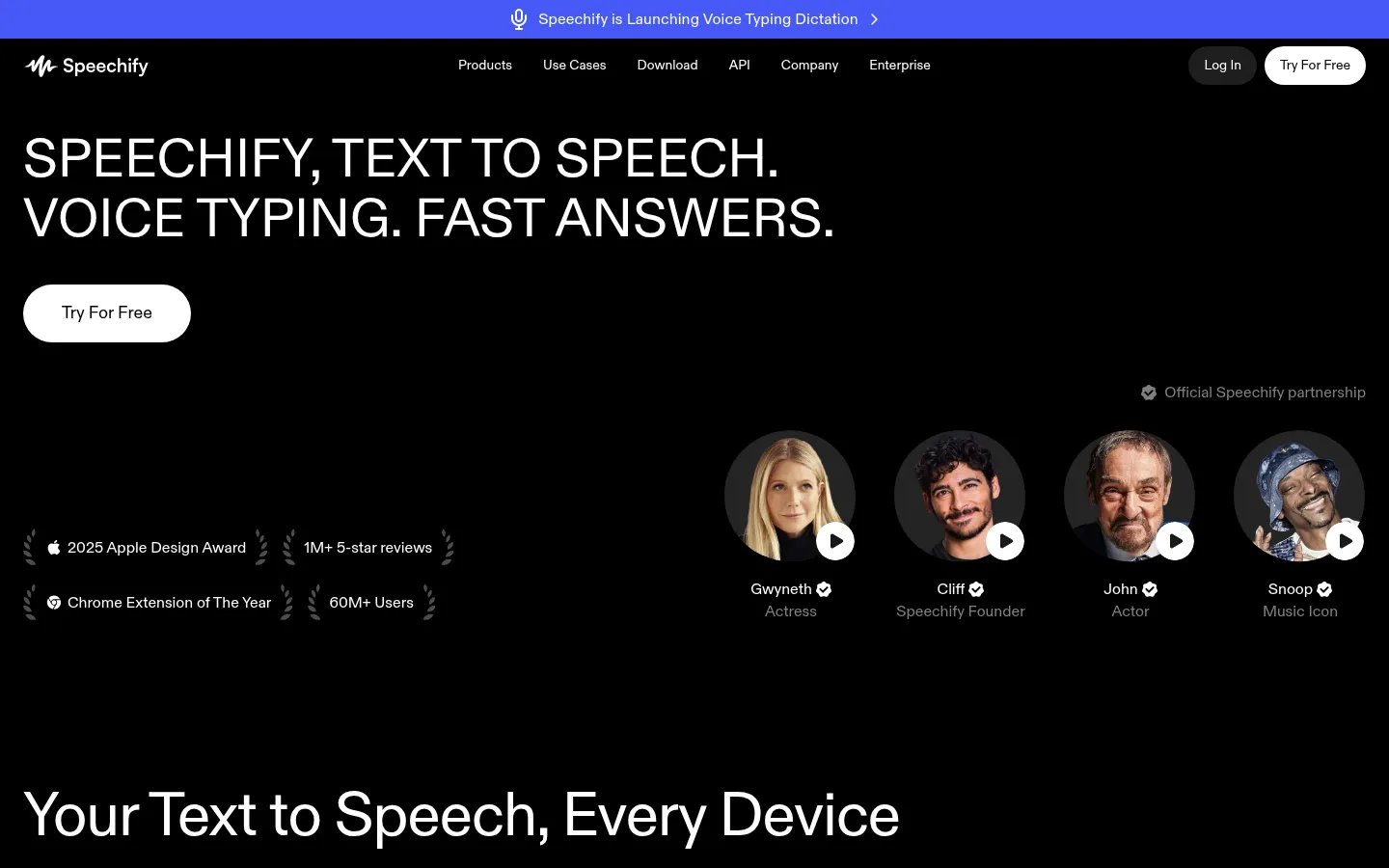
Speechify
Two products under one name: a text-to-speech reader for listening to documents, and Speechify Studio, a voiceover and dubbing tool with voice cloning.
Strengths
- +The best listening experience: it reads PDFs, web pages, and docs aloud at speeds up to 5x on Premium, with apps for iOS, Android, Mac, Windows, and Chrome
- +Studio Starter at $100 a year is a low yearly entry price with voice cloning and commercial rights included
- +Dubbing in about 20 languages, and the Studio plans state SOC 2 approval and that you own the output
Weaknesses
- -Reader and Studio are separate subscriptions, so the $29 reader plan does not give you voiceover credits
- -Changing pitch, speed, or emotion re-runs the AI and spends credits, so heavy editing eats the allowance
- -Studio covers about 20 languages, fewer than ElevenLabs' 74 or Murf's 30+
Heads up: Check which Speechify you are buying. Its pricing page says outright that Studio is a different subscription from the Text to Speech Reader, and reviews of one often get applied to the other.
The Reader app is free with 10 robotic-sounding voices and playback up to 1.5x, and Premium is $29/month billed monthly with 1,000+ voices, 60+ languages, and 5x speed. Studio is a separate subscription: Free gives 600 credits and no commercial rights, Starter is $100/year for 86,400 credits (about 24 hours of voiceover) with voice cloning and commercial rights, and Creator is $300/year for 345,600 credits (about 96 hours). Voiceover costs 1 credit per second and dubbing 3 credits per second (checked 5 October 2026).
Visit Speechify →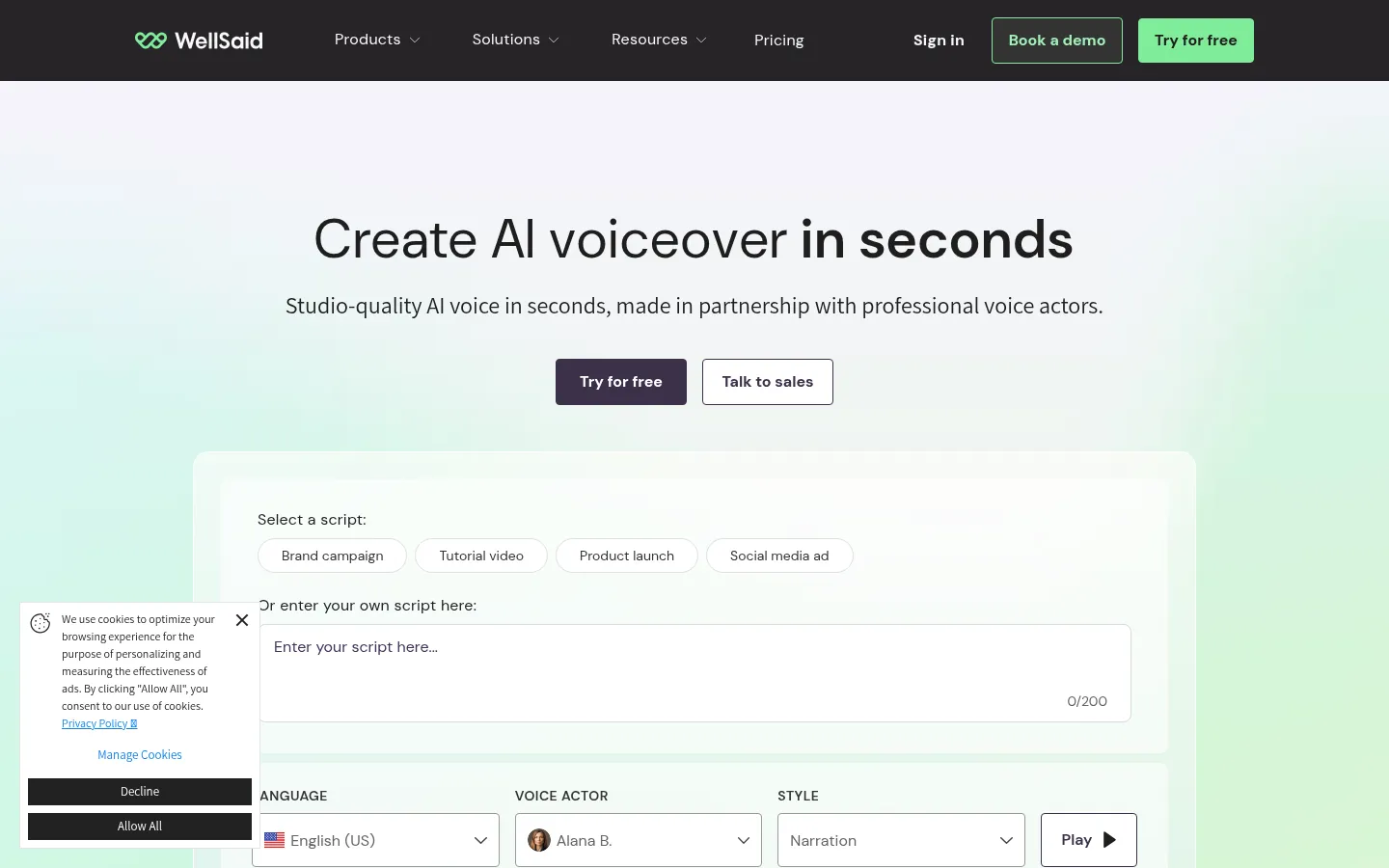
WellSaid
A voiceover studio built around licensed voice actors, with tone, pitch, and pronunciation controls, unlimited regenerations, and SOC 2 Type 2 certification.
Strengths
- +Voices made in partnership with professional voice actors, and customer data is never used to train its models
- +Unlimited generation and retakes on paid plans, with tone, pitch, and emotional controls, pronunciation customization, and caption files (SRT and VTT)
- +SOC 2 Type 2 and GDPR on every plan, and Adobe Express and Premiere Pro integrations
Weaknesses
- -Only 20 downloadable minutes a month on Starter's monthly plan, and unused minutes do not roll over
- -English voices only on individual plans: other languages and translation are Enterprise
- -No cloning on any plan listed, so you cannot create a voice of your own without talking to sales
Heads up: WellSaid counts downloaded minutes, not generated ones. You can regenerate as often as you like, but each finished clip you export draws down the plan, and a canceled plan locks you out of your projects.
Free gives 3 downloadable minutes a month and no commercial rights. Starter is $10/month billed annually ($120 a year; $19 monthly) with 240 downloadable minutes a year, 10 projects, and full commercial rights. Pro is $33/month annually ($396 a year; $49 monthly) with 2,160 minutes a year, unlimited projects, up to 48 kHz audio, and an Adobe Express integration. Business is $160 per user per month annually for up to 5 seats, with WAV and OGG export. Enterprise adds other languages, translation, SSO, and 96 kHz audio. Generation is unlimited on paid plans; only downloaded minutes are counted (checked 5 October 2026).
Visit WellSaid →Feature comparison matrix
Beyond the scored criteria, here's how each tool handles the practical questions that come up once you're actually building: code ownership, design import, team access, and starting price.
| Feature | ElevenLabs | Cartesia | Fish Audio | Murf | Speechify | WellSaid |
|---|---|---|---|---|---|---|
| Free plan | Yes (10,000 credits, about 10 min) | Yes (20,000 credits, about 27 min) | Yes (8,000 credits, about 7 min) | Yes (10 min in Studio) | Studio: 600 credits (about 10 min) | Yes (3 min a month) |
| Paid plan from | $5/mo annual ($6 monthly) | $5/mo (Pro) | $11/mo annual ($15 monthly) | $19/mo annual (Creator) | $100/year (Studio Starter) | $10/mo annual ($19 monthly) |
| Commercial use starts at | Starter | Pro | Plus (paid plans) | Creator | Studio Starter | Starter |
| Self-serve voice cloning | Yes (instant: Starter; professional: Creator) | Yes (instant: Pro; professional: Startup) | Yes (from the free plan) | No (Enterprise only) | Yes (Studio Starter) | Not listed |
| Languages | 74 | 40+ (reported) | 30+ | 30+ (Studio) | About 20 (Studio) | English (others on Enterprise) |
| Voice editor for long scripts | Yes (Studio projects) | No (API-first) | Partial (Story Studio) | Yes (scenes, plugins) | Yes (Voiceover Studio) | Yes (retakes, captions) |
| Developer API | Yes (ElevenAPI) | Yes (core product) | Yes (paid plans) | Yes ($0.01 per 1,000 characters) | Yes (separate pricing) | Yes |
| Unused usage rolls over | Yes (up to 2 months, paid) | Yes (up to 2x monthly rate) | No | Not stated | Not stated | No |
Ranked for your specific situation
The ranking above weighs every criterion equally. If cost, ownership, or a specific skill matters more to you than the others, we re-ran the same test data weighted for these audiences:
For Free Users
Cartesia is the best free AI voice generator in 2026: 20,000 free credits a month is about 27 minutes of speech, against roughly 10 at ElevenLabs and 7 at Fish Audio. None of the free plans allows commercial use.
Read more →For YouTube & Video Creators
ElevenLabs is the best AI voice generator for YouTube in 2026: Starter at $6 a month includes a commercial license and instant voice cloning, and Creator at $22 gives about 121 minutes of speech. Fish Audio is the cheaper pick at $11 a month billed annually.
Read more →For Developers & Voice Agents
Cartesia is the best AI voice generator for developers in 2026: the API is the product, a commercial license starts at $5 a month, and a reviewer measured 82ms end to end on Sonic 3.5. ElevenLabs is the stronger pick when you also need 74 languages and professional cloning.
Read more →Already using one of these? See alternatives
If you're evaluating a switch away from a specific tool, we break down exactly where it falls short and what to replace it with:
Cartesia alternatives
The free plan is for testing, not publishing: the commercial use license starts at Pro. Also note that credits are characters, so a script full of break tags spends extra credits, because each break tag counts as one.
Read more →Fish Audio alternatives
Check the voice you pick before you publish. Fish Audio's pricing FAQ says premium subscribers can use verified voices that they own for commercial purposes, so a community voice from the library is not automatically cleared for an ad or monetized video.
Read more →Murf alternatives
Murf's voice generation allowance is set per year on annual plans, not per month, so heavy months can use up the year quickly. The homepage now leads with agents and the API, but the Studio plans above are still sold.
Read more →Speechify alternatives
Check which Speechify you are buying. Its pricing page says outright that Studio is a different subscription from the Text to Speech Reader, and reviews of one often get applied to the other.
Read more →WellSaid alternatives
WellSaid counts downloaded minutes, not generated ones. You can regenerate as often as you like, but each finished clip you export draws down the plan, and a canceled plan locks you out of your projects.
Read more →Frequently Asked Questions
What is the best AI voice generator in 2026?
ElevenLabs is the best AI voice generator in our 2026 ranking, scoring 52/60. It has the most natural voices, 74 languages, self-serve voice cloning, and a commercial license from $5-$6 a month. Cartesia (47/60) is the better pick for free use and real-time apps, and Fish Audio (46/60) is the cheapest way to clone a voice.
What is the best free AI voice generator?
Cartesia has the most free text to speech: 20,000 credits a month, about 27 minutes. ElevenLabs gives about 10 minutes and Fish Audio about 7, and WellSaid's free plan is 3 minutes a month. None of the free plans includes a commercial license, so anything you publish needs a paid plan.
Which AI voice generator sounds the most human?
ElevenLabs, according to the review pages and user threads we read. Its v3 model adds audio tags such as [whispers] and [sighs] to direct emotion, and it handles 74 languages. Fish Audio, Cartesia, Murf, and WellSaid are close for straight narration. We did not run a blind listening test, so try the free plans with your own script.
Can I use AI voices commercially?
Only on paid plans, and the entry plan differs: ElevenLabs Starter, Cartesia Pro ($5), Murf Creator, WellSaid Starter, Speechify Studio Starter, and Fish Audio's paid plans. Free plans are personal use only. Fish Audio also says only verified voices that you own are cleared for commercial use, so a community voice is not automatically licensed.
Can I clone my own voice?
Yes, with ElevenLabs (instant cloning from Starter, professional from Creator), Fish Audio (from about 10 to 15 seconds of audio), Cartesia (instant from $5 Pro, professional from $49 Startup), and Speechify Studio. Murf lists professional cloning only on its API Enterprise plan, and WellSaid lists no cloning.
How much does an AI voice generator cost?
Paid plans start at $5-$11 a month for a creator: Cartesia Pro $5, ElevenLabs Starter $6 ($5 annually), WellSaid Starter $10 annually, Fish Audio Plus $11 annually, and Murf Creator $19 annually. Speechify Studio is $100 a year. Prices checked 5 October 2026.
What is the best AI voice generator for YouTube videos?
ElevenLabs. Starter at $6 a month includes a commercial license and instant voice cloning, Creator at $22 gives about 121 minutes, and its Studio and dubbing tools help with longer videos and other languages. Fish Audio is the cheaper alternative at $11 a month annually for about 200 minutes.
What is the best AI voice generator for developers and voice agents?
Cartesia. Its API is the product, with separate concurrency pools for speech, transcription, and agents, a commercial license at $5, and a reviewer-measured 82ms end-to-end latency on Sonic 3.5. ElevenLabs has a broader API and agent platform, but reviewers say its v3 model is too slow for live conversation.
Did Play.ht shut down?
Yes, according to TechSifted: Meta acquired the PlayAI team in July 2025, and the platform shut down permanently on 31 December 2025 with no migration path. Several older roundups still list it. We did not verify this on Play.ht's own site, which is why it is not in the ranking.
What is the difference between text to speech and a voice generator?
In practice they are the same thing. Text to speech turns a script into audio, and an AI voice generator adds voice cloning, emotion control, and an editor, which is where the tools here differ. Speechify's reader is a listening app, while its Studio is the voiceover tool.
About the writer
Jake Sullivan
Senior Content Researcher
Jake runs the majority of Benchmark Lab's hands-on testing - executing the identical test script across every tool in a category, logging what succeeded, what failed, and how long each step took. He writes up the results for the categories and comparisons he tests directly.
Read more →